
South Korean AI Firefighting System Autonomously Targets Shipboard Oil Fires
An AI‑driven firefighting system developed by South Korean researchers has completed shore and shipboard trials, autonomously detecting petroleum fires and directing foam monitors to extinguish them while compensating for ship motion.
Researchers at the Korea Institute of Machinery and Materials (KIMM) say they have developed an autonomous firefighting platform that can identify pool‑type petroleum fires, activate foam sprayers and concentrate extinguishing discharge on the blaze without human intervention.
The system addresses a specific naval risk of oil fires caused by leaking distillate fuel from engines, generators, or embarked aircraft.
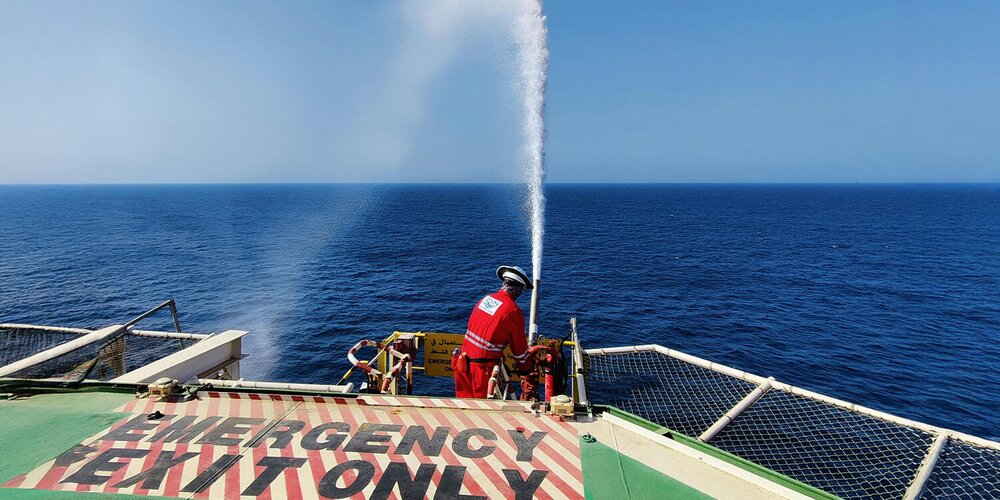
The design uses directed foam monitors with a range of roughly 18–24 metres to concentrate suppressant precisely on the burning surface, minimising unnecessary flooding and equipment damage.
Early validation took place in a land‑based ship motion simulator that replicates the interior motion environment of real vessels.
In those tests the system proved highly discriminating, avoiding false activations from commonplace heat sources such as welding arcs, lighters, and heaters. KIMM reports detection accuracy in excess of 98% during their experimental runs.
The team developed a real‑time control algorithm that factors in the vessel’s roll and pitch to continually correct aim, enabling reliable delivery of foam to a moving target while underway.
That capability was demonstrated aboard the ROKS Ilchulbong (a Republic of Korea Navy tank landing ship) during sea trials in waves of approximately one metre, where the system successfully engaged test fires from stand-off ranges of around 60 feet.
The combination of sensor fusion, machine‑learning fire classification, and motion‑compensated targeting distinguishes the platform from earlier fixed systems and from simple automatic monitors.
KIMM and its team highlight the broader applicability of the technology beyond warships. Military supply facilities, aircraft hangars, offshore energy installations and, potentially, petrochemical plants could benefit from autonomous, precision firefighting systems that cut damage and speed suppression.
Further work will focus on durability, integration with shipboard alarm and damage‑control systems, and certification to naval and civilian standards. The team also plan expanded trials across diverse vessel types and higher sea states to validate long‑term reliability and maintainability under operational conditions.
If adopted, the technology promises to change damage‑control protocols by allowing localised, automated responses to high‑risk hydrocarbon fires without the widespread disruption caused by full‑compartment flooding.
However, naval architects and operators will need to weigh integration complexities, lifecycle maintenance and interoperability with existing firefighting protocols before wide scale deployment.
KIMM’s researchers say the system can materially boost ship survivability and safety at hazardous sites ashore and afloat. The successful sea trials mark a significant step towards operational use of AI‑guided active safety systems in maritime environments.
Fire response and investigation services at Brookes Bell
Major fires and explosions are among the greatest hazards facing the global maritime industry. So whether you want to reduce your exposure to risk, or conduct a detailed investigation into a fire or explosion incident, speak to Brookes Bell today.
With our multidisciplinary team based across the world, we are able to deliver results that yield long-term benefits for you in the event of a fire incident.
Speak to Brookes Bell about your fire investigation or safety requirements today.
Learn more about our fire response and investigation services
For more maritime industry insights, news and information, read the Brookes Bell News and Knowledge Hub…
A Brief History of the Suez Canal | The World's Largest Container Ships | Iraq’s Al Faw Port and “Dry Canal” to Rewrite the Global Trade Map
- Author
- Andrew Yarwood
- Date
- 30/12/2025