
The M.V. Falmouth Bay Incident: What Happened ?
The humble container has transformed both shipping and global trade. But, it hasn’t eliminated the dangers and risks of transporting cargoes at sea. But, as one particular incident shows us, with experienced seafarers on board, even serious incidents can be rescued. This is the story of the M.V. Falmouth Bay incident…
The M.V. Falmouth Bay: a short history
Beginning life as the Marestar, the M.V. Falmouth Bay was a container ship that had been built by Ishikawajima Harima Heavy Industries in Tokyo for Marester Reederei GmbH & Co KG.
The M.V. Falmouth Bay’s specifications
The M.V. Falmouth Bay was an impressive container ship for the late 1970s, lengthened in 1981 and subsequently had a gross tonnage of 15,503, a deadweight of 21,178 tonnes, and a cargo capacity of 1,266 teu.
It was 178.42m in length, with a breadth of 26.10m, a depth of 13.62m, and a draught of 9.42m.
This considerable bulk was pushed through the water by a 6-cylinder 2 SCSA Sulzer diesel engine that, with its 13,300 bhp, could propel the vessel to a service speed of 18.30 knots.
The M.V. Falmouth Bay enters service
The M.V. Falmouth Bay may have been launched in July 1978 as the Marestar, but by the time it was delivered in December 1978, it had been renamed as Seatrain Trenton (later names would include Falmouth Bay, Orient Winds, Mosel Express, Strathbora, Luck River, and of course Falmouth Bay).
It was under the name Seatrain Trenton that the vessel began its operational life. It would happily carry out its duties for just over a year until it was sold to Overseas Containers Ltd in September 1980.
With the change of owners, came a change of management. In February 1981, management of the Seatrain Trenton was transferred to Container Fleets Ltd, with the vessel being simultaneously renamed Falmouth Bay.
By June 1981, management of the vessel was transferred directly to Overseas Containers Ltd.
Overseas Containers Ltd
Overseas Containers Ltd (OCL) was a consortium of British shipping companies that had been formed in 1965.
The genesis of OCL had been the advent of containerisation. Containerisation, although leading to savings in the medium to long term, required significant investment in vessels and infrastructure.
In order to ease this financial burden, many shipping companies banded together into consortia.
OCL was the result of a partnership between British and Commonwealth Shipping, Furness Withy, P&O, and the Ocean Steamship Company.
The consortium proved to be a success, and by the early 1980s OCL had cemented its position as Europe’s largest container-through-transport operator. It was this growth that had necessitated the addition of the Falmouth Bay to its 20-strong fleet.
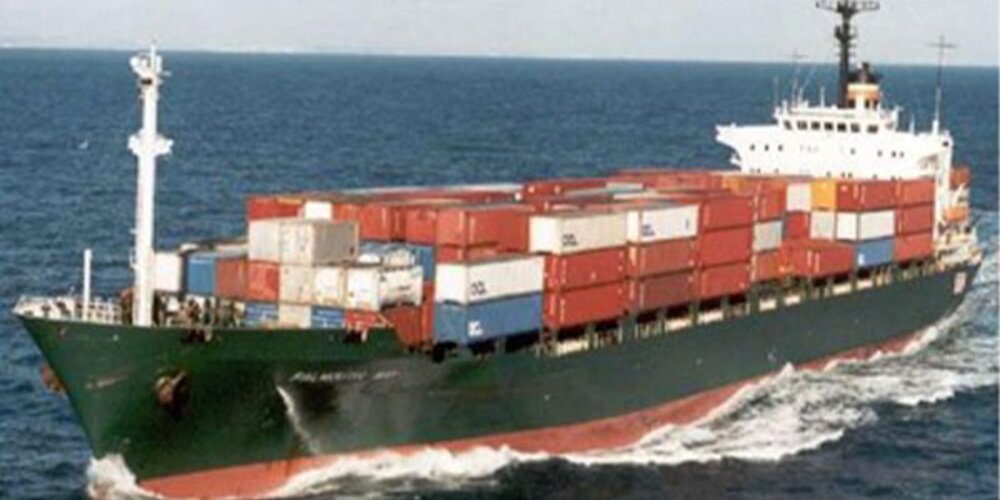
OCL’s fleet of container vessels - including the Falmouth Bay - was easily recognised thanks to their green hulls, white superstructure, and green funnels bearing the initials OCL in white letters.
OCL also adopted a common naming convention for its fleet, with all ships’ names ending in the word ‘Bay’.
Other than Falmouth Bay, other ships within OCL’s fleet included Encounter Bay, Tokyo Bay, Liverpool Bay, Osaka Bay, Cardigan Bay, Jervis Bay, Flinders Bay, Botany Bay, Encounter Bay, Discovery Bay, Moreton Bay, Remuera Bay, Table Bay, Resolution Bay, and Mairangi Bay.
Modifications to the Falmouth Bay
It was whilst the Falmouth Bay was being operated on behalf of OCL that it was modified to increase its capacity.
In August 1981, the vessel was sent to be lengthened. It returned to service in September 1981.
It was during this subsequent period of service that the Falmouth Bay would undergo the incident for which it became well known in shipping circles…
- Author
- Anthony York
- Date
- 14/12/2022