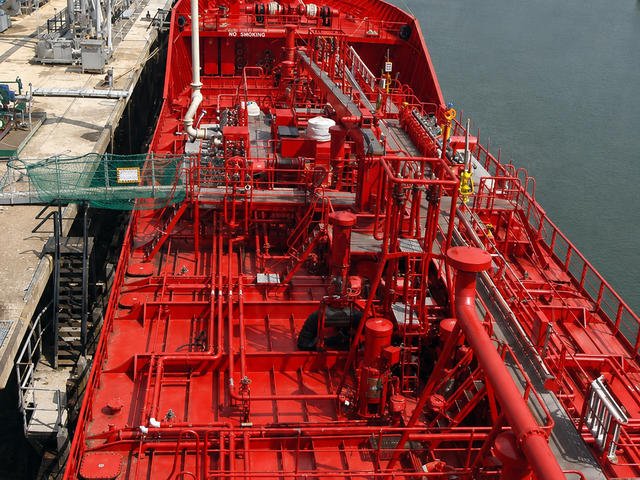

Contamination following vegetable oil cargoes and other high-viscosity cargoes is not always a tank-cleaning failure. Residues trapped in cargo lines, valves, manifolds, stripping lines and dead-end sections can compromise subsequent high-grade cargoes, even where tanks have passed standard cleanliness checks.
If you want to avoid costly claims, and ensure your wider cargo system is properly assessed, speak to Brookes Bell now.
When a clean tank is not a clean cargo system
Cargo tanks may be cleaned, inspected, and tested, but contamination can still arise from the wider cargo system.
Whilst tank cleaning programmes after cargoes like vegetable oils are well-defined, associated pipework is often overlooked. Residues may remain in stagnant or low-flow areas of the cargo system, particularly where lines are not flushed early, opened fully, drained correctly, or incorporated into the cleaning plan.
Picture the scene: a cargo tank has passed visual inspection, wall-wash testing, first-foot sampling, and perhaps even wash-water analysis. Yet, on arrival at the discharge port, the cargo is found to be contaminated.
The culprit is often the cargo piping system. A clean tank does not necessarily equate to a clean cargo system.
Why cargo line residues matter
Cargo contamination risks can dwell deeper within a vessel’s cargo system – where residues from previous vegetable oil and other high-viscosity cargoes can remain trapped.
The consequences can be significant. Even a relatively small amount of contamination may result in:
- Cargo rejection.
- Product downgrade.
- Delays to loading or discharge.
- Disputes between owners, charterers, cargo interests, and insurers.
In more serious cases, inadequate line-cleaning can contribute to off-hire claims, P&I claims, and wider reputational damage.
As a result, cargo line cleaning should not be treated as a secondary cleaning procedure – it should be an integral part of a vessel’s normal tank-cleaning plan, with specific steps and enough time allocated to do the job properly.
Don’t just ask, “Is the tank clean?” - ask, “Are the lines, valves, drains, dead ends, small pipes, vapour lines, hatches, and measurement points clean, too?”
How Brookes Bell can help
Cargo contamination incidents – including those caused by insufficient line cleaning – are rarely straightforward.
Determining where residues may reside in the system, how to remove them, and how to prevent them from accumulating in the first place, are all challenging, but mitigatable risks.
Brookes Bell provides independent technical support to help you understand, manage and resolve these risks.
Our specialists can assist on both a proactive and reactive basis:
- Before problems arise by reviewing cargo cleaning procedures and identifying potential contamination pathways.
- After an incident has occurred by investigating causation, assessing evidence and supporting claims or dispute resolution.
Our complete cargo line cleaning consultancy services are detailed below.
Cargo contamination investigations
When cargo contamination occurs, Brookes Bell can help identify the likely source, mechanism, and extent of the issue.
Our investigation may include reviewing:
- Recent cargo history.
- Tank and cargo line cleaning records.
- Sampling records.
- Wall-wash and first-foot results.
- Relevant operational documents.
- Potential contamination sources across the cargo handling chain.
We assess whether contamination may have originated from the cargo tanks, cargo lines, valves, drains, manifolds, shore systems, previous cargo residues, or other sources.
Our experts’ findings provide a clearer technical understanding of what happened, why it happened, and where responsibility may sit. Where required, our support can also assist with cargo claims, insurance matters, charterparty disputes, and commercial discussions between owners, charterers, cargo interests, and insurers.
Tank and cargo line cleaning procedure review (integrating line cleaning into cleaning programmes)
Effective contamination prevention requires more than visibly clean tank surfaces. When tankers move from vegetable oils or other high-viscosity cargoes to sensitive or high-grade cargoes, the wider cargo system must also be considered.
Our experts can review your cargo system cleaning processes to assess whether they properly account for:
- Cargo lines and associated systems.
- Flushing sequences.
- Hot-water and chemical washing.
- Steaming and rinsing.
- Valve operation.
- Line drainage.
- Dead ends, small-bore lines, and manifold arrangements.
By identifying overlooked or under-addressed areas, we provide practical recommendations to improve cleaning reliability, reduce contamination risk, and support more robust decision-making before the next cargo is loaded.
On-board inspection and technical attendance
Where vessel-specific assessment is required, Brookes Bell can attend on board to inspect relevant cargo system arrangements and provide practical technical advice.
This may include reviewing high-risk areas such as:
- Cargo line dead ends.
- Manifold drains.
- Stripping lines.
- Cargo and manifold valves.
- Drop lines.
- Deck heat exchanger lines.
- Vapour return and P/V valve lines.
- Sounding pipes, UTI connections, and other deck penetrations.
Our on-board attendance can be especially valuable where repeated cleanliness issues have occurred, a sensitive cargo is due to be loaded, or there is uncertainty over whether the full cargo system has been adequately cleaned.
Dispute and expert support
When contamination results in cargo rejection, delay, off-hire, product downgrade or financial loss, independent technical evidence can be critical.
Brookes Bell can provide expert support for:
- Cargo contamination claims.
- Charterparty disputes.
- Insurance matters.
- Legal proceedings.
- Causation analysis.
- Contamination pathway assessment.
- Review of cleaning and sampling evidence.
- Independent technical opinions.
By combining our deep maritime operational knowledge with scientific and forensic expertise, we help you establish a clearer, evidence-based position.
Supporting safer cargo transitions
We’re also here to help when you need to manage those critical transitions between cargoes. Brookes Bell can help you assess the full cargo system when you need to:
- Assess whether a vessel is suitable for a planned cargo change.
- Investigate contamination linked to a previous cargo.
- Evaluate the effectiveness of tank cleaning between cargoes.
- Identify risks associated with cargo residues in connected systems.
- Support claims and disputes arising from cargo transition issues.
By looking beyond the cargo tank alone, we help reduce the risk of avoidable cargo quality issues.
Areas of the cargo system we assess
In our experience, potential contamination can reside in multiple parts of the broader cargo system. As a result, we take a ‘deep dive’ approach, ensuring that all possible areas of contamination are examined. These areas include:
| Area Assessed | Rationale |
| Cargo lines and drop lines | Residues can remain on internal pipe surfaces, particularly where flow rates are low or drainage is incomplete. |
| Manifolds and manifold drains | Manifold arrangements contain multiple connections, drains and low points where previous cargo residues may collect. |
| Cargo line crossovers | Unused or partially used crossover sections can create stagnant areas where cargo residues may remain trapped. |
| Blind flanges and dead ends | Dead-end sections are a common source of retained cargo because they may not receive effective flow during routine washing. |
| Cargo valves and valve seats | Residues can remain around valve bodies, seats and sealing surfaces if valves are not properly operated during cleaning. |
| Stripping lines | Small-diameter stripping systems can retain cargo residues and may require specific attention during flushing and drainage. |
| Small-bore lines | Narrow pipework is more prone to blockage, hold-up and ineffective flushing, particularly after viscous cargoes. |
| Deck heat exchanger lines | Associated lines, including drop lines, can retain residues if they are not flushed and drained as part of the cleaning programme. |
| P/V valve lines | Pressure-vacuum valve lines may be overlooked during cleaning but can still provide a pathway for residue or contamination. |
| Vapour return lines | Vapour systems can contain residues, vapour-phase deposits or oil mist, depending on the previous cargo and operating conditions. |
| Fixed tank-cleaning lines | Lines not used during a specific cleaning operation may still require flushing to prevent retained residues. |
| Sounding pipes | Full-height sounding pipes can trap residues and may be vulnerable to blockage after vegetable oil or other viscous cargoes. |
| UTI connections | Measurement points and deck penetrations can retain cargo residues and may require targeted flushing or inspection. |
| Hatch gaskets and seals | Residues can remain trapped around seals and later migrate back into the cargo space if not properly exposed to the wash medium. |
| Tank-cleaning and access hatches | Hatch areas can act as localised residue traps, particularly where gaskets, seals, and surrounding surfaces are not adequately cleaned. |
Through this, we can help you move beyond a ‘tank-only’ view of cleanliness and embrace a ‘whole-system’ approach to avoiding cargo contamination issues.
When to involve Brookes Bell
Not sure when you should contact us about your cargo line cleaning concerns?
Here are the times when our specialists can assist and advise:
- A sensitive chemical or high-grade cargo is due to be loaded after vegetable oil or another high-viscosity cargo.
- Tank inspections appear satisfactory, but contamination is still suspected or has occurred.
- Repeated wall-wash, first-foot, or cleanliness issues are delaying operations.
- Vessel cleaning procedures need to be reviewed or strengthened.
- There is uncertainty over whether cargo lines, valves, drains, and connected systems have been adequately cleaned.
- Contamination is suspected, but the source is unclear.
- A cargo contamination investigation is required after discharge.
- A dispute has arisen between owners, charterers, cargo interests, receivers or insurers.
- Procedures are being developed for high-risk cargo changeovers.
By involving Brookes Bell early, you can better understand contamination risk, identify overlooked pathways, and make more informed decisions before cargo quality issues escalate.
Reduce your operational and commercial exposure with Brookes Bell
Effective cargo contamination prevention depends on understanding the entire cargo system, not just the visible tank surfaces. By reviewing the vessel-specific risks associated with cargo lines, valves, drains and ancillary pipework and infrastructure, Brookes Bell can help you reduce the likelihood of avoidable contamination, cargo rejection, delays and disputes.
Contact us now to discuss your requirements.