
A Guide to Bulk Vessel Sizes
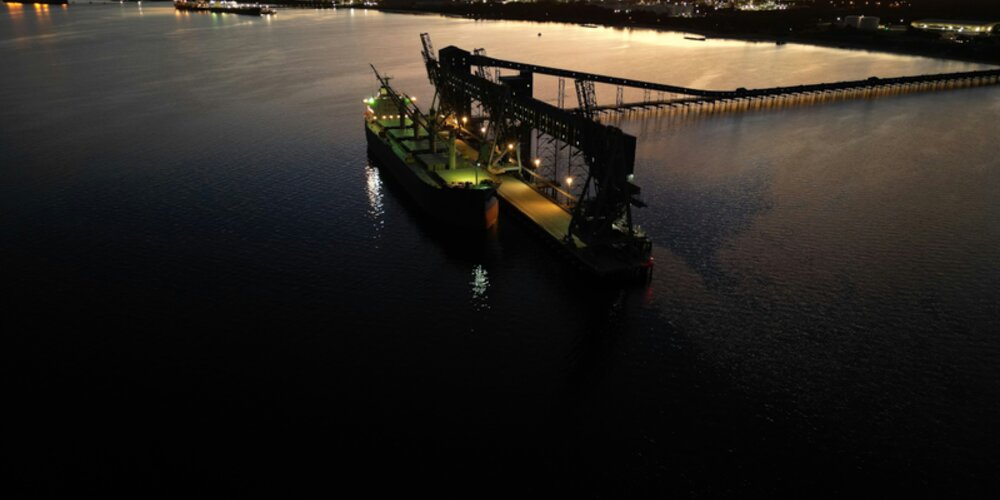
Ask most people in shipping what a bulk carrier’s “size” actually tells you, and the answer can get vague fast – a DWT figure, a hold count, a canal restriction, rarely the same thing twice. It can be especially confusing for people who are new to the industry.
This guide maps the most common bulk carrier size classes, from mini-bulkers to the 400,000-DWT Valemax and explains what each means in practice.
What is a bulk carrier?
If there’s only one thing that you take away and remember from this article, it should be this – bulk carrier sizes are not official definitions, but rather commercial nomenclature that are used by brokers, charterers and others as a useful heuristic when calculating what size vessel they need for a particular cargo and/or route.
That said, the SOLAS Convention (Regulation IX/1.6) sets out the technical definition of a bulk carrier as: “Bulk carrier means a ship which is constructed generally with single deck, top-side tanks and hopper side tanks in cargo spaces and is intended primarily to carry dry cargo in bulk, and includes such types as ore carriers and combination carriers”.
In practice: bulk carriers are designed to carry cargoes listed in the IMSBC and Grain Codes and these can include grain, coal, ore, cement – poured or grabbed in directly. While not a bulk carriers’ primary cargo there has been a developing trend to use bulk carriers to carry break bulk cargoes such as steel coils and vehicles.
This distinction separates a bulk carrier from its closest relatives, including:
- Container ships: which move standardized boxes, whereas bulk carriers generally move loose commodity cargo with no unitization at all.
- General cargo (breakbulk) ships: breakbulk vessels can use multiple ‘tween decks for palletised or crated goods, whereas a bulker has one open hold built purely for volume.
- Tankers: tanker move bulk liquid (oil, chemicals), thus “dry bulk carrier” exists specifically to mark that distinction.
The one blurred line is the combination carrier – though these are now a near-extinct niche.
Bulk carrier sizes: from Handysize to Valemax
Every class below is typically described by deadweight tonnage (DWT) – the total weight a ship can carry to her marks, including cargo, fuel, and stores – rather than gross tonnage (GT), which provides an indication of a vessel’s volume.
As we mentioned earlier in this article, as opposed to being formal ‘definitions’, bulk carrier sizes are used in an informal, commercial nature by charterers and brokers to quickly determine the size of vessel needed for a particular cargo nomination.
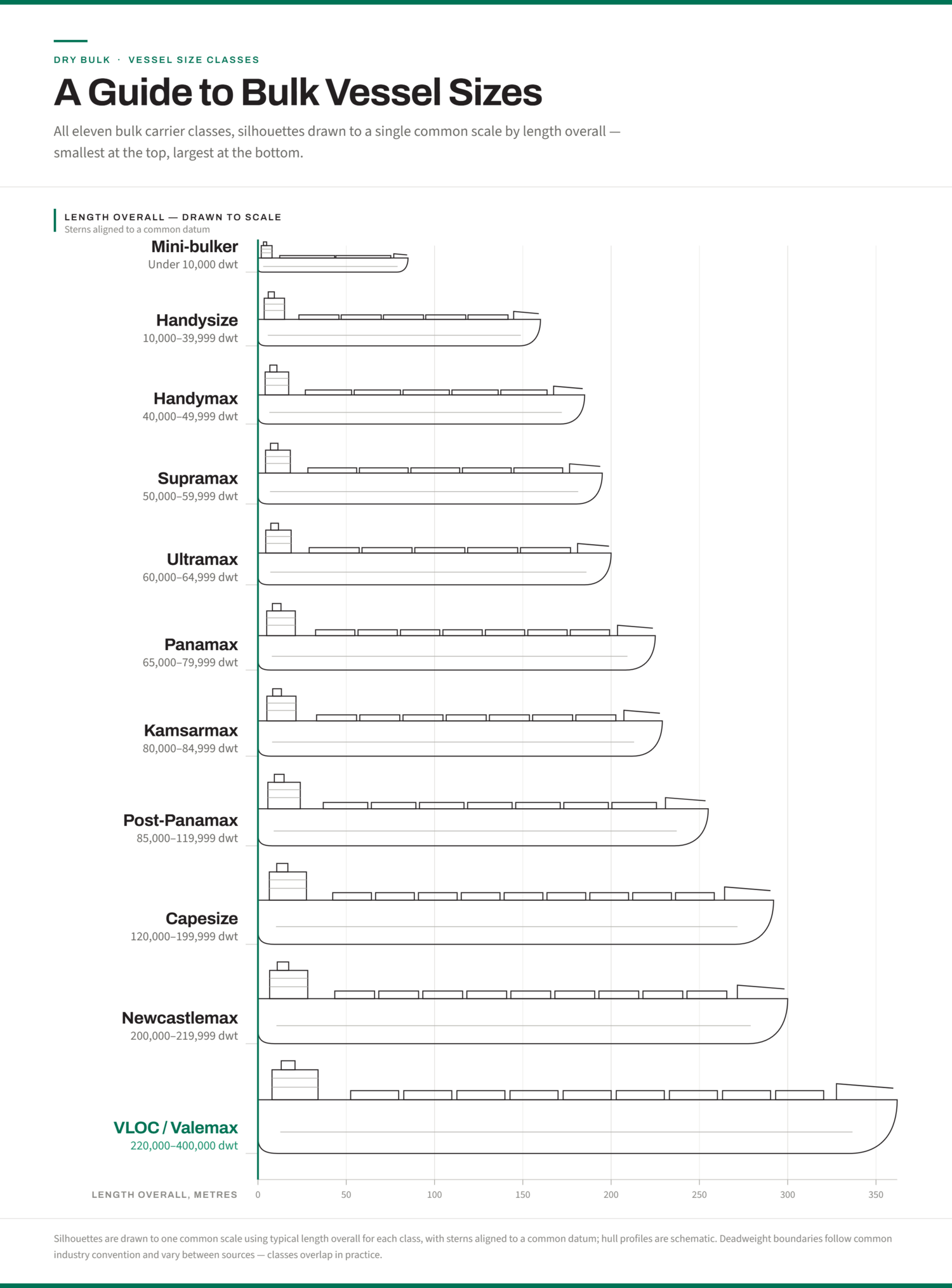
Below, we’ve detailed some of the more common bulk cargo sizes that you’ll see used in commercial shipping circles.
Size Class | DWT Range | Length Overall | Defining Constraint |
Mini-Bulker | Up to ~10,000-15,000 | 100-130m | River/bridge clearance |
Handysize | 10,000-39,999 | 130-180m | Small-port access |
Handymax | 40,000-49,999 | 150-200m | No single hard limit |
Supramax | 50,000-59,999 | ~190m | No single hard limit |
Ultramax | 60,000-65,000 | 200-220m | Stretch of Supramax, still geared |
Panamax | 65,000-89,999 | Up to 294.13m | Original Panama Canal locks (32.31m beam) |
Kamsarmax | ~80,000-85,000 | Up to 229m | Port Kamsar, Guinea (Bauxite) |
Post-Panamax | 85,000-120,000 | Up to 366m | Expanded Panama Canal locks (2016) |
Capesize | 100,000-199,999 | ~290m | Rounds Cape Horn/Good Hope |
Newcastlemax | ~185,000-210,000 | Up to 300m | Port of Newcastle, Australia |
VLOC/Valemax | 200,000-400,000+ | Up to 362m | Deepwater ore terminals (Vale) |
Note: these names are not arbitrary. Each records a real chokepoint a ship was built to fit under: Panamax the original Panama Canal locks (32.21m beam), Kamsarmax the 229m berth limit at Guinea’s bauxite port, Newcastlemax a 50m beam restriction at Newcastle, Australia. The “-max” suffix simply means “as large as this constraint allows”.
Frequently asked questions about bulk carriers
The topic of bulk carriers and their size and classes raises the same handful of questions again and again. So, here are the answers to the ones we are asked the most.
What do bulk cargo carriers transport?
By their very design, bulk cargo carriers are tailored to transport both raw and finished products – commodities. Typical commodity cargoes transported by bulk vessels include (but are not necessarily limited to):
- Iron Ore: the backbone of steelmaking – the material that makes the modern world possible, found in everything from buildings and vehicles to infrastructure and consumer products.
- Grain: wheat, maize, rice, and other similar grain products that keep the world fed.
- Coal: the backbone of energy production across many developed and developing nations.
- Fertiliser: a critical input for global agricultural production.
- Cement: a fundamental input for large infrastructure and construction projects.
As the above list makes clear, bulk vessels (and the cargoes they carry) are fundamental to contemporary industrial society, providing the inputs that are crucial to modern Ricardian specialisation.
What is the difference between a cargo ship and a bulk carrier?
“Cargo ship” is the umbrella term for any vessel that carries goods. A bulk carrier is the specialised subtype built for loose, unpackaged dry bulk. It differs from container ships (packaged cargo in containers), general/breakbulk ships (unitised cargo on multiple decks), and tankers (liquid bulk, not dry).
Which is the biggest/largest bulk carrier ship in the world?
The largest bulk carriers are Valemax-class very large ore carriers built for Brazilian mining conglomerate Vale.
The lead ship, MS Ore Brasil, carries roughly 402,000 DWT across a 362m hull, a record confirmed by Guinness World Records, which lists the 68-ship Valemax fleet as the largest dry bulk carriers ever built.
What are the two main ‘types’ of bulk carriers?
This question usually refers to the split based on cargo-handling gear. Geared bulk carriers carry their own cranes and can work ports without shore equipment, typically Handysize through Ultramax; gearless bulk carriers rely entirely on terminal infrastructure, typically Panamax and above, trading flexibility for extra cargo capacity.
What is deadweight tonnage (DWT)?
DWT is the total weight a ship can carry when loaded to her marks – cargo, fuel, stores, and crew combined. As UNCTAD puts it, DWT indicates a ship’s cargo-carrying capacity, whilst gross tonnage (GT) reflects its size instead.
Why size class is more than a number
Knowing the difference between a Handysize and a Kamsarmax – is the first step in understanding the commercial communications about bulk carriers.
In practice, the physical constraints behind a class (a canal lock, a berth length, a terminal draft) is usually more useful than the DWT figure on its own, especially once cargo risk or hold configuration enters the picture.
Whatever size of bulk carrier you are dealing with, Brookes Bell’s Master Mariners and Cargo Scientists will be able to assist with advice on navigation, cargo operations, cargo condition, and the mitigation of cargo claims.
Explore our Master Mariner services today
For more maritime industry news, insights and developments, read the Brookes Bell News and Knowledge Hub…
The World’s Largest Shipbuilding Companies | MARPOL: What You Need to Know | SOLAS: A Century of Safety and Counting
- Author
- Andrew Yarwood
- Date
- 02/09/2026