
What Is Dynamic Positioning? An Introduction
Some ships don’t drop anchor. Instead, they use a network of thrusters, computers, and sensors to hold their exact position at sea – sometimes for weeks at a time, sometimes mere metres from an oil platform, a wind turbine, or another vessel. This is Dynamic Positioning (DP), and it underpins some of the most valuable operations in the maritime and offshore energy industries.
This article explains what DP is, why it carries commercial as well as technical risk, and why an independent assessment – beyond the standard class trial – is worth commissioning before problems find you.
What is Dynamic Positioning?
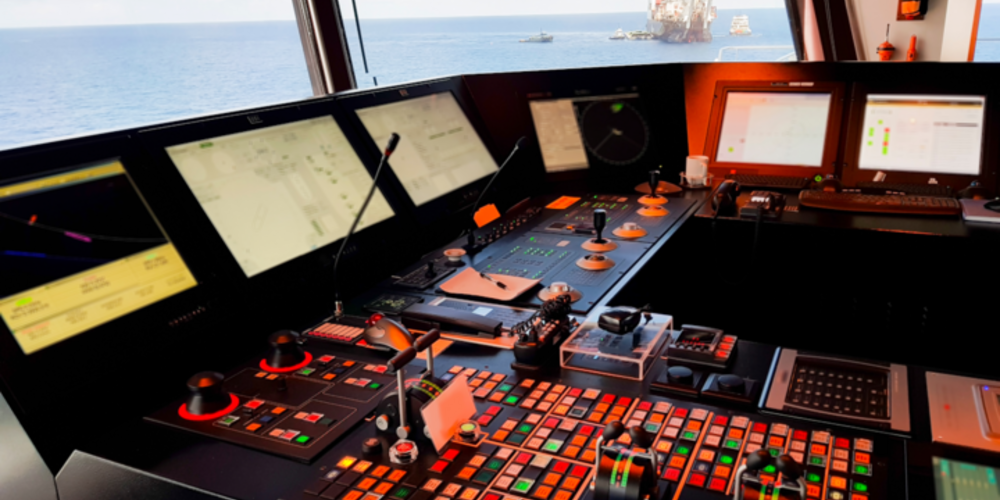
Dynamic Positioning (DP) uses computer-controlled thrusters and reference sensors to hold a vessel’s position and heading automatically, without anchoring.
In practice, a DP control system continuously calculates the vessel’s exact position and heading – usually cross-checking several independent reference sources, such as satellite positioning, acoustic beacons on the seabed, or laser systems reading off a fixed structure.
It compares that position against where the vessel is supposed to be, then automatically commands the thrusters to counteract wind, waves, and current, and correct any drift, dozens of times a second.
Vessels are assigned a DP class notation – broadly, DP1, DP2, or DP3 – depending on how much redundancy is built into the system.
A DP1 vessel can lose position in the event that a single component fails. Whereas, a DP3 vessel is built with full redundancy, including physically separated equipment, so that no single failure – or even a fire or flood in one compartment – should cause a total loss of position.
DP matters commercially because of what it’s used for.
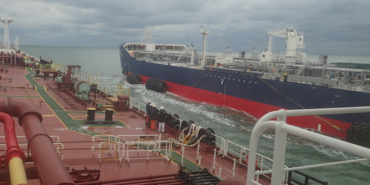
Drilling support, subsea construction and inspection work, cable and pipe lay, heavy lift, offshore wind installation, and cargo transfer at floating production platforms are all typically high day-rate, high-value operations that depend on the vessel holding position exactly, for extended periods, often close to expensive fixed infrastructure or other vessels.
Because so much depends on DP performing exactly as intended, when it doesn’t, the consequences can be severe – and rarely confined to the vessel itself.
Why a DP incident can be a commercial problem, not just a technical one
The direct repair cost of a DP incident is rarely the largest cost – the commercial fallout usually is instead.
When a DP incident occurs, the immediate technical response – investigation, repair, re-trial – is only the first cost. Several other costs may follow, including:
- Off-hire time: a vessel undergoing investigation or repair isn’t earning a day rate, and depending on the charter party, the owner may also carry the charterer’s own costs during that downtime.
- Charter party disputes: questions of liability, fitness for purpose, and whether the vessel met its DP capability plan can turn a single incident into a prolonged commercial dispute.
- Reputational cost: offshore energy, drilling, and renewables charterers operate within a relatively small circle of vetted vessels and operators. An incident – even a well-handled one – can affect vetting and tendering for future work.
- Insurance exposure: depending on the nature and cause of the incident, hull & machinery and P&I exposure can follow, along with the administrative cost of the claims process itself.
None of this means a Dynamic Positioning incident is inevitable, or that any particular vessel is at risk.
It means that for a vessel operating in DP-dependent work, the commercial exposure of getting it wrong is often proportionate to the value of the work itself – which, for offshore construction, drilling support, and renewables installation, is often substantial.
To put this more bluntly, if DP fails – and the vessel collides with an offshore structure such as a wind turbine – the resulting damages and costs can be significant.
What a class notation tells you – and where independent assessment adds to the picture
A vessel’s DP class notation, its FMEA study, and its annual DP trial are well-established, important indicators of capability. An independent DP assessment isn’t a substitute for any of them – it’s a complementary layer, designed to sit alongside them.
Class notation and annual trials are typically carried out at a point in time, under conditions set out for that specific exercise. An independent assessment can look at things that may fall outside the scope of a single trial – for example, how equipment condition and maintenance practices have evolved since the last trial, how today’s crew (who may differ from those present at the last trial) respond in day-to-day operation, and whether documented procedures continue to reflect how the vessel is currently run.
None of this suggests that class notation or the trial process is inadequate – both remain essential, industry-recognised measures.
Rather, it reflects that different types of assessment serve different purposes, and that ongoing, independent review can add a further layer of assurance between formal surveys.
What an independent DP assessment covers
An independent DP assessment is designed to add that further layer of assurance – covering the vessel, the paperwork, and the people. Brookes Bell’s DP assessment services, led by Master Mariners, are structured around six areas:
- DP System Evaluation: the condition, calibration, and maintenance effectiveness of DP control systems, thrusters, sensors, and power management equipment.
- Compliance & Assurance Review: how current procedures and documentation measure up against IMO, IMCA, class, and company standards.
- DP Capability Assessment: how the vessel performs under a range of environmental and operational conditions, including worst-case failure scenarios.
- DP Personnel Competency Evaluation: the training, experience, and practical competence of DPOs, technical staff, and vessel management.
- DP Risk & Operational Review: the operational and human factors that a purely technical survey may not capture.
- Improvement Plan & Recommendations: a clear, practical report setting out what to strengthen, and how.
Our Master Mariners lead the assessment from start to finish – and because they’ve stood the DP watch themselves, competency and procedure get the same scrutiny as the equipment. Where a finding calls for deeper engineering or naval architecture input, that expertise sits within the same team.
Questions you should be asking now
For shipowners
- When was our DP capability last independently reviewed, beyond the class trial?
- How confident are we in our current DPO’s competency records, not just their certificates?
- If a charterer’s vetting team asked to see our DP risk assessment tomorrow, would we be ready?
For charterers:
- Does the vessel’s real-world DP capability match its capability plan for the specific operation we’re fixing it for?
- Has the vessel’s DP system and crew been assessed since its last incident-free period – or only after something went wrong?
The bottom line
A DP assessment isn’t an additional compliance burden stacked on top of class requirements – it’s a way of pricing in a risk that’s already there, before a charterer, an insurer, or an incident prices it in for you.
Brookes Bell’s Master Mariners carry out independent DP assessments for ship owners and charterers across the offshore, drilling, subsea, and renewables sectors.
Find out more about our DP assessment services now
For more maritime industry news, insights and developments, read the Brookes Bell News and Knowledge Hub…
Navigating Risks: Unravelling Dynamic Positioning Dangers in Offshore Drilling Semis | Kongsberg Marine Invests in Advanced Anchor Handling Simulator | New Harbour Tug Design Demonstrates Big Efficiency & Performance Gains
- Author
- Matt Donnelly
- Date
- 07/09/2026