
Container Losses at Sea: Causation, Recovery Options and Claims Support
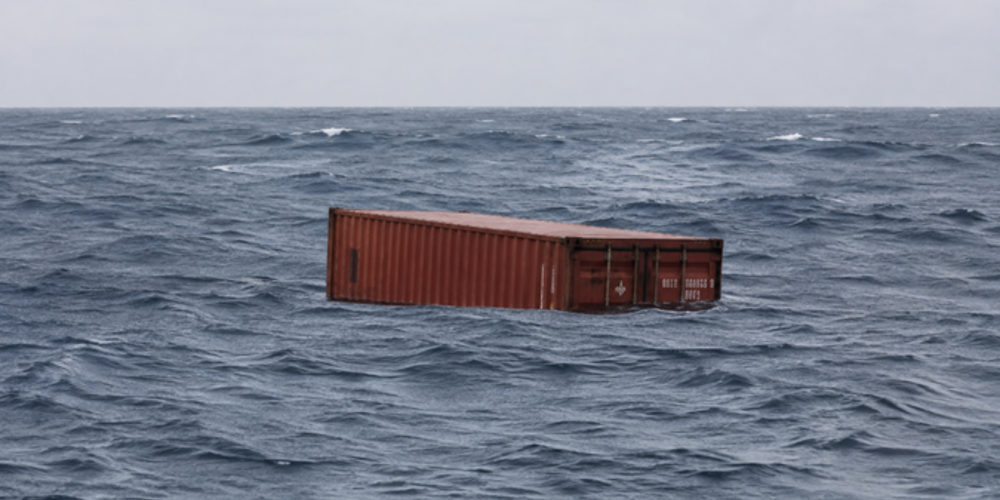
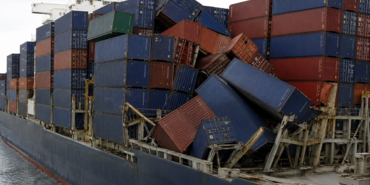
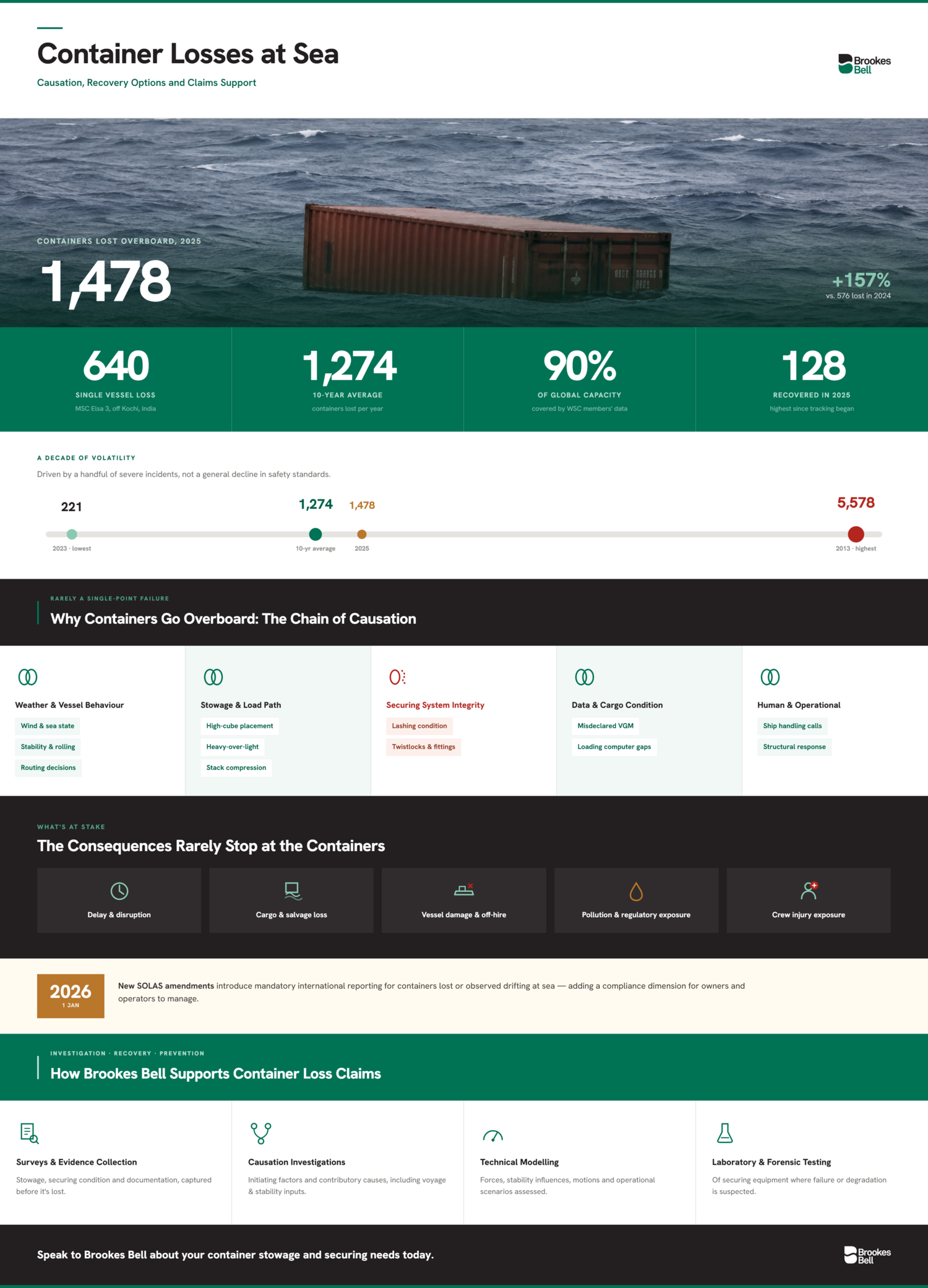
Container losses have moved back up the industry’s risk agenda. The World Shipping Council’s latest update to its annual Containers Lost at Sea report puts the 2025 total at an estimated 1,478 containers lost overboard – more than double the 576 lost in 2024, out of roughly 280 million containers transported globally that year.
A single vessel casualty, the loss of containers from the MSC Elsa 3 off Kochi, India, accounted for around 640 of that total on its own.
These figures are a useful reminder of something we see repeatedly in our own casualty work: the loss of containers at sea is rarely a single-point failure. More often, it’s a chain or combination of factors – stowage assumptions, weight accuracy, securing condition, stability settings, weather exposure, and voyage decisions.
Breaking that chain before sailing, and documenting it properly after an incident, can materially reduce the overall loss and improve recovery prospects.
How Many Containers Are Lost at Sea Each Year?
The number varies significantly year-to-year and is usually driven by a small number of severe incidents rather than a general decline in safety standards. Over the last decade, the World Shipping Council’s members – who operate over 90% of global containership capacity – have recorded an average of around 1,274 containers lost annually, ranging from a low of 221 in 2023 to a high of 5,578 in 2013.
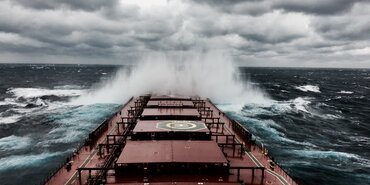
The 2025 increase was concentrated: one major incident accounted for roughly 43% of the year’s losses, whilst severe weather and warmer-than-normal ocean conditions in the North Atlantic and North Pacific, along with fires, were cited as the primary drivers behind the rest. On a more positive note, 128 containers were recovered in 2025 – the highest number since the WSC began tracking recovery data in 2023.
Reporting is also changing. From 1st January 2026, amendments to SOLAS have introduced mandatory international requirements for reporting containers lost or observed drifting at sea, which should improve the accuracy and consistency of this data going forward – adding a further compliance dimension for owners and operators to manage.
Why Do Containers Go Overboard? Understanding the Chain of Causation
When Brookes Bell is instructed to investigate a container loss, we’re looking for the combination of factors that allowed a single point of weakness to become an incident. The areas that most often affect liability, coverage positions, and the strength of any recovery include:
Weather and vessel behaviour
- Wind, sea state and stack exposure, including wind stacks and forecast route exposure.
- Stability, vessel motions and rolling – GM and stability inputs, weather and sea loads, parametric or synchronous rolling.
- Weather routing decisions and seakeeping performance under the conditions actually encountered.
Stowage and load path
- Stowage design choices such as high-cube placement, heavy-over-light or localised high loads.
- Stack racking and compression weakness.
Securing system integrity
- The condition and maintenance of lashing equipment.
- Deck fittings – twistlocks, lashing points and their foundations.
Data, compliance and cargo condition
- Missing lashing rods, loading computer inputs, and oversight gaps.
- Misdeclared weights and VGM discrepancies.
- Cargo shift within the container due to inadequate internal cargo securing, resulting in abnormal internal loads.
Human and operational factors
- Ship handling decisions made by the Master in the conditions faced.
- Structural response of container stacks and towed cargo under sea loads.
No two incidents involve the same combination, which is exactly why early, structured evidence-gathering matters – it’s what allows a causation opinion to withstand scrutiny later, whether that’s from a P&I club, an underwriter, or opposing counsel.
What’s at Stake When Containers Are Lost
The consequences of a container loss incident rarely stop at the containers themselves:
- Delay and disruption, with associated consequential cost exposure.
- Cargo and container losses, and the salvage and recovery considerations that follow.
- Vessel damage, repair scope, and potential off-hire.
- Pollution and regulatory exposure, including reporting obligations under the new SOLAS requirements.
- Crew injury exposure.
Each of these carries its own evidential and commercial pressures, which is why early attendance and a clear investigative approach matter as much as the technical findings themselves.
How Brookes Bell Supports Investigation, Recovery, and Prevention
We can attend quickly, secure key documents and evidence, and provide clear opinions on causation – whether you’re instructing us in the immediate aftermath of an incident or seeking an independent pre-voyage review.
Our container loss services include:
- Surveys & Evidence Collection: stowage and securing condition, damaged units, documentation and statements, captured before evidence is lost or degraded.
- Causation Investigations: identifying initiating factors and contributory causes, including voyage and stability inputs.
- Technical Modelling: assessing the forces, stability influences, motions, and operational scenarios involved.
- Laboratory & Forensic Testing: of securing equipment where failure or degradation is suspected.
If you’ve had an incident, or you’d like an independent pre-voyage review of stowage, lashing arrangements, stability inputs and voyage planning assumptions, Brookes Bell is here to help.
Speak to Brookes Bell about your container stowage and securing needs today
For more maritime industry insights, news and information, read the Brookes Bell News and Knowledge Hub…
The World’s Biggest Container Shipping Companies | SOLAS: A Century of Safety and Counting | India Launches Its First National Container Shipping Line
- Date
- 27/08/2026