
Heavy Weather Damage Claims: What Underwriters & Owners Need to Know
When cargo arrives damaged and the log records a force 10 gale, the weather looks like the answer. Under English law it rarely is. The courts don’t ask whether the storm was extraordinary – they ask whether the loss was fortuitous and whether the owner’s negligence contributed. The burden of proving that sits squarely with the carrier.
This article covers where the law now stands, how cover responds, what evidence decides these claims, and the red flags that a weather defence won’t hold.
What Counts as Heavy Weather Damage
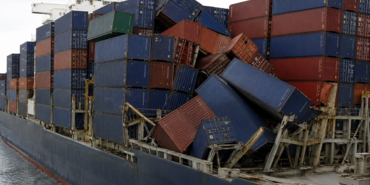
Heavy weather damage is physical damage to a vessel’s hull and structure, or to its cargo, caused by wind and sea conditions encountered in transit – buckled forepeak plating, collapsed container stacks, shifted bulk cargo, seawater ingress through hatch covers etc.
The term is descriptive rather than legal, which is why disputes turn on what the parties mean by it.
Other key points to be aware of include:
- The line against wear and tear: Section 55(2)(c) of the Marine Insurance Act 1906 excludes ordinary wear and tear, and the same boundary runs through the law of carriage: the ordinary action of wind and waves is not a peril of the sea. Attributing damage to an identifiable encounter rather than to accumulated service is threshold question in most hull claims.
- Why the log entry isn’t the answer: Masters record weather in Beaufort force and Douglas sea state. Both are observational estimates – the WMO (World Meteorological Organization) now prefers direct readings from wave buoys and anemometers. A log entry is evidence, but weak evidence, and it can be tested against hindcast data.
How Heavy Weather Damages Ships and Cargo
Heavy weather damages ships in several distinct ways, each leaving a different signature – and identifying which mechanism operated is the first step in establishing whether a loss was fortuitous or predictable.
Causes of damage include :
- Ship motions: synchronous rolling occurs when the wave encounter period matches the natural roll period; parametric rolling when it is roughly half, so the righting moment varies as the vessel meets two crests per roll cycle. ClassNK notes it particularly affects slender hulls with pronounced flare – e.g. container ships and car carriers.
- Structural loads: slamming excites the hull girder into transient vibration, or whipping. The danger is cumulative: whipping bending moments superimpose on wave-induced bending moments, threating longitudinal strength in a way neither would alone.
- Container stack collapse: stacks fail when transverse accelerations exceed what the securing can resist, upper tiers first. Which component failed – lashing rods, twistlocks, corner castings, deck fittings – decides most of these claims.
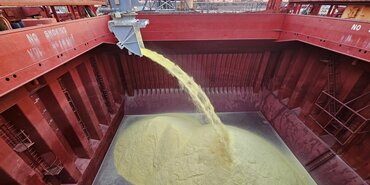
- Bulk cargo: amendments effective December 2023 added dynamic separation alongside liquefaction as a Group A mechanism. Cargo looking dry at loading can still destabilise under voyage compaction. Heavy weather is often the trigger, rarely the cause.
- Wet damage: seawater ingress and freshwater condensation look alike and are legally distinct. Chloride testing separates them, and the distinction usually determines who pays.
- The stiff ship problem: dense cargoes stored low give a high GM, and roll period varies inversely with the square root of GM – a stiff ship snaps back fast, punishing securing systems. A vessel can meet every stability criterion and still be poorly suited to her cargo.
Why Bad Weather Alone Is Not a Defence
The instinct in a heavy weather claim is to reach for severity: the worse the storm, the stronger the defence. However, English law does not work that way.
Here are some key points to consider:
- Fortuity, not severity: to succeed under the perils of the sea exception, a carrier must show something fortuitous – an accident that might happen, not an event that must. What matters is whether the loss was an accident of the sea, not whether the conditions were exceptional. A vessel striking a submerged object in clam water can qualify; a vessel labouring in a predictable winter gale may not.
- Foreseeable weather can still qualify: this surprises people. English law, unlike the US and Canadian approach, does not require the weather to have been extraordinary or unforeseeable. A storm that was forecast, and that the Master knowingly sailed into, can still be a peril of the sea. The defence is limited by the carrier’s own conduct – negligence and unseaworthiness – rather than by how predictable the weather was.
- The ordinary action of wind and waves is excluded: Rule 7 of Schedule 1 to the Marine Insurance Act 1906 puts it directly: perils of the seas covers fortuitous accidents, not the ordinary action of the winds and waves. Every vessel works in a seaway. Damage that reflects the accumulated effect of normal service – fatigue cracking, coating breakdown, steel wastage – is wear and tear, whoever’s log it appears in.
The practical consequence is that establishing a storm gets an owner nowhere on its own. It is a starting point, not an answer – and the questions that follow it are the ones that decide the claim.
Who Has to Prove What
Most heavy weather disputes are decided not by what happened at sea, but by who carries the burden of proving it. That burden has shifted significantly in the past decade, and much of the guidance still in circulation reflects the old position.
Important points to consider are as follows:
- The cargo claimant’s opening case is straightforward.
- The carrier must then disprove its own negligence.
- Unseaworthiness defeats the defence outright.
In short, a heavy weather defence now turns on the condition of the ship and the conduct of her crew – which is why evidence matters more than the storm.
What Evidence Decides the Claim
If the law puts the burden on the carrier to disprove negligence, the practical question becomes what the owner can actually prove – and that depends on decisions taken in the days after the voyage, not the months after the claim.
Evidence that can be particularly pertinent to a claim includes:
- Log books, tested against hindcast: the deck log is usually the first document produced and the least reliable. Entries in Beaufort force and Douglas sea state are subjective estimates, made in poor conditions, often by an officer alive to how the entry will read later. They can be checked against independent hindcast data – buoy records, satellite altimetry, model reanalysis etc. Where the log records materially worse weather than the hindcast supports, the discrepancy does more damage to the owner’s case than the underlying facts would have.
- VDR data, before it is lost: voyage data recorders capture bridge audio, radar, and ECDIS imagery, heading, speed, and motion data. Retention is limited – 48 hours on the capsule under the current standard, and only 12 hours on older installations. Data not downloaded promptly is simply gone, and its absence tends to be read against the party who lost it.
- Hatch covers and chloride testing: leaking hatch covers are the most common cause of wet damage to cargo. Ultrasonic tightness testing records give evidence of due diligence; sealing tape or foam found in place suggests the opposite. Where damage is disputed, chloride testing distinguishes seawater ingress from freshwater condensation – and that distinction usually determines liability.
- Fatigue or overload? When lashings, twistlocks, or securing points fail, metallurgical analysis can show whether the failure was progressive or the result of a single extreme load. Fatigue points to a pre-existing defect and unseaworthiness. Overload supports the weather. The same broken component can carry either answer.
Conclusion
Heavy weather is a starting point in a claim, not an answer. The perils of the sea defence turns on fortuity rather than severity, and since Volcafe it is the carrier who must show that its own negligence played no causative part – a cast that fails outright if the vessel was unseaworthy. Severity of weather, in other words, is rarely the deciding factor. The condition of the ship and the conduct of her crew usually are.
That makes the response in the days after an incident more consequential than anything argued later. VDR data overwrites, crews change, and physical evidence is repaired or discarded – often before anyone has decided a claim will be pursued. Owners who preserve records early are in a position to prove due diligence; those who do not are left arguing from a log book that will be tested against independent data.
Brookes Bell’s cargo damage investigation and expert witness teams are instructed by owners, underwriters, and law firms to establish what actually caused a loss – combining Master Mariner, naval architecture, and materials science expertise built on firsthand casualty investigation.
Speak to Brookes Bell about heavy weather damage claim support today
For more maritime industry insights, news and information, read the Brookes Bell News and Knowledge Hub…
Cargo Line Cleaning: Why a Clean Tank May Not Mean a Clean Cargo | Stranded Sulphur Cargoes in the Strait of Hormuz Face Mounting Corrosion Risk, Warns Brookes Bell | The Fire Tetrahedron: The Science Behind Brookes Bell’s Marine Fire Investigations
- Date
- 25/08/2026